 Correo Electrónico
 DNINFOA - SIA
 Bibliotecas
 Convocatorias
 Identidad U.N.



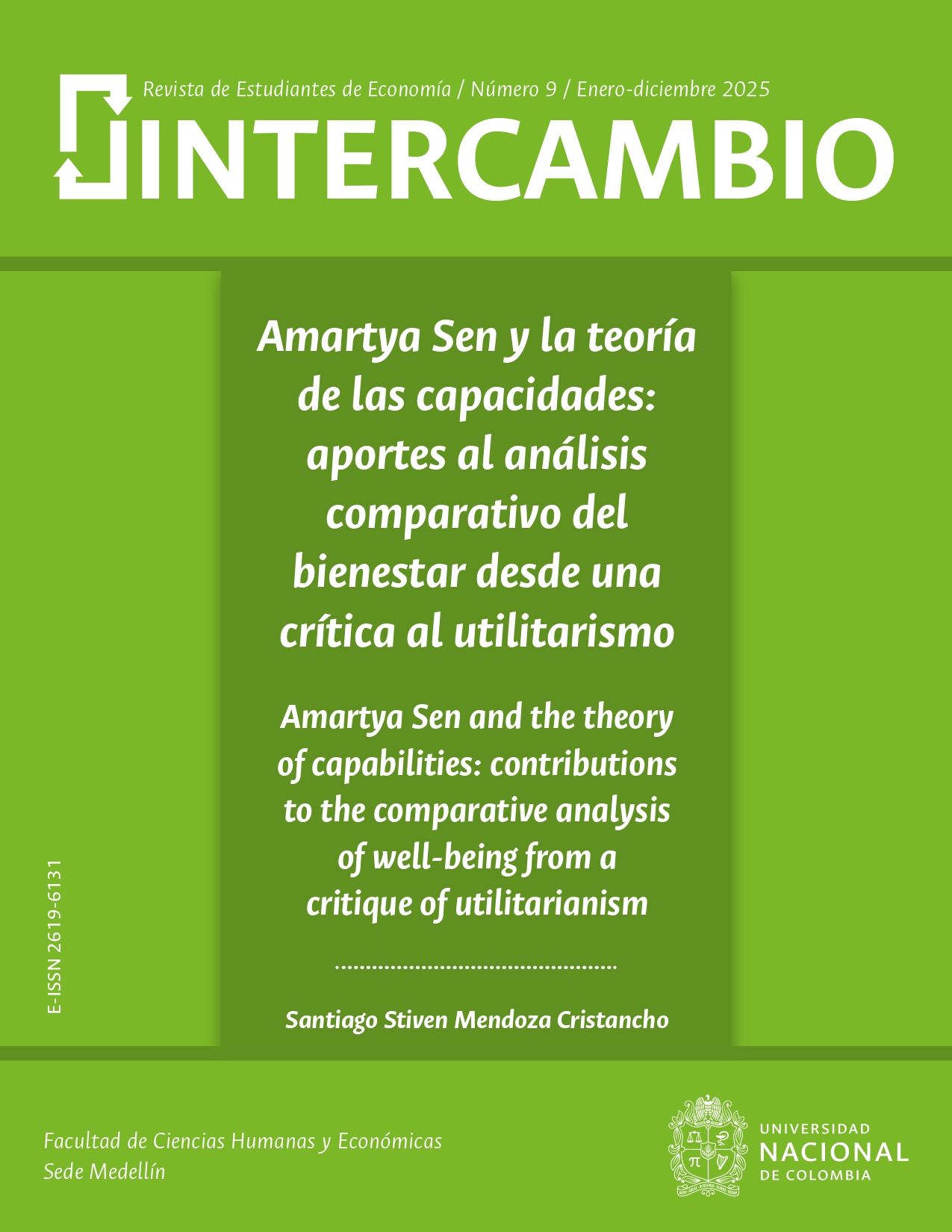
Amartya Sen and the theory of capabilities: contributions to the comparative analysis of well-being from a critique of utilitarianism
Keywords:
well-being, capabilities, functionings, utilitarianism, interpersonal comparisonsAbstract
This study presents a theoretical analysis of Sen’s capability approach and a formalization of its fundamental elements, with the purpose of assessing and identifying its contributions to the analytical structure of welfare economics as a socially oriented
field directed toward praxis. In particular, it examines the approach’s contributions to the comparative problem that arises when evaluating welfare across individuals, a task that requires the consideration of fundamental ethical-philosophical concepts and cohe rent economic postulates. The analysis begins with a critical reflection on the utilitarian approach adopted by the traditional paradigm of welfare economics — and on its constitutive elements and derives the problem of making interpersonal welfare comparisons. Finally, the study identifies three contributions of Sen’s approach to the comparative problem: the expansion of the informational basis of welfare, the development of the concept of basic capabilities through the definition of thresholds, and the provision of a theoretical foundation for constructing multidimensional welfare indices.
References
Aristóteles, y Bonet, J. P. (1985). Ética nicomáquea: Ética Eudemia. Gredos Editorial S.A.
Arrow, K. J. (1950). A difficulty in the concept of social welfare. Journal of political economy, 58(4), 328-346.
Arrow, K. J. (1970). Social Choice and Individual Values. Yale University Press. https://books.google.ie/books?id=KelwxwEACAAJ
Atkinson, A. B. (1999). The contributions of Amartya Sen to welfare economics. The Scandinavian Journal of Economics, 101(2), 173-190.
Blanco, O. R., y Sam, O. R. F. (2014). Teoría del bienestar y el óptimo de Pareto como problemas microeconómicos. REICE: Revista Electrónica de Investigación en Ciencias Económicas, 2(3), 217-234.
Casas, A. F., Cortés, D., y Gamboa, L. F. (2003). LAS COMPARACIONES INTERPERSONALES Y LA EVALUACIÓN DE ESTADOS SOCIALES ALTERNATIVOS. Revista de Economía Institucional, 5(8), 147-160. https://dialnet.unirioja.es/descarga/articulo/2329140.pdf
Colmenarejo, R. (2016). Enfoque de capacidades y sostenibilidad. Aportaciones de Amartya Sen y Martha Nussbaum. Ideas, 65(160), 121–149. https://doi.org/10.15446/ideasyvalores.v65n160.43084
Edgeworth, F. Y. (1881). Mathematical Psychics: An Essay on the Application of Mathematics to the Moral Sciences. C. K. Paul. https://books.google.ie/books?id=s7cJAAAAIAAJ
Forster, E. S. (1920). Oeconomica. Clarendon Press. https://books.google.es/books?id=PvoIAQAAMAAJ
Graaff, J. D. V. (1967). Teoría de la Economía del Bienestar (M. Fernández, Trad.). Amorrortu. (Obra original publicada en 1957).
Kemp, M. C., y Ng, Y. K. (1976). On the existence of social welfare functions, social orderings and social decision functions. Economica, 43(169), 59-66.
Kuhn, T. S. (2019). La estructura de las revoluciones científicas (C. Solis, Trad.). Fondo de cultura económica. (Obra original publicada en 1962)
Marshall, A. (1890). Principles of Economics (8th ed.). Macmillan. https://oll.libertyfund.org/titles/marshall-principles-of-economics-8th-ed
Ng, Y.-K. (2004). Welfare economics: Towards a more complete analysis. Palgrave Macmillan.
Nussbaum, M., y Sen, A. (Eds.). (1993). The quality of life. Clarendon press.
Pareto, V., Montesano, A., Zanni, A., Bruni, L., Chipman, J. S., & McLure, M. (2014). Manual of Political Economy: A Variorum Translation and Critical Edition. OUP Oxford. (Obra original publicada en 1906). https://books.google.es/books?id=M3ZYAwAAQBAJ.
Parks, R. P. (1976). An impossibility theorem for fixed preferences: a dictatorial Bergson-Samuelson welfare function. The Review of Economic Studies, 43(3), 447-450.
Pigou, A. C. (1946). La economía del bienestar. (F. Sánchez, Trad.) M. Aguilar. (Obra original publicada en 1920).
Programa de las Naciones Unidas para el Desarrollo [PNUD]. (2022). Informe sobre desarrollo humano 2021/2022. https://hdr.undp.org/informe-sobre-desarrollo-humano-2021-22
Programa de las Naciones Unidas para el Desarrollo [PNUD]. (2025). *Tabla 1: Índice de Desarrollo Humano y sus componentes* [Conjunto de datos]. Informes sobre Desarrollo Humano del PNUD. Recuperado el 22 de Abril de 2025, de https://hdr.undp.org/data-center/documentation-and-downloads
Programa de las Naciones Unidas para el Desarrollo [PNUD]. (s.f.). Índice de desarrollo humano. https://hdr.undp.org/data-center/human-development-index#/indicies/HDI
Robeyns, I., y Byskov, M. F. (2025). The capability approach. En E. N. Zalta y U. Nodelman (Eds.), The Stanford Encyclopedia of Philosophy (Summer 2025 ed.). Recuperado de https://plato.stanford.edu/archives/sum2025/entries/capability-approach/
Ross, W. D., y Smith, J. A. (1920). The Works of Aristotle: Politica, by B. Jowett. Oeconomica, by E.S. Forster. Atheniensium respublica, by F.G. Kenyon. Clarendon Press. https://books.google.com.co/books?id=9VgXAQAAMAAJ
Ruggles, N. (1957). La economía del bienestar como base del principio marginalista de la formación de los precios. Revista de economía política, 8(2).
Sen, A. (1970). Collective Choice and Social Welfare. Holden-Day. https://books.google.ie/books?id=kzq6AAAAIAAJ
Sen, A. (1985). Well-Being, Agency and Freedom: The Dewey Lectures 1984. The Journal of Philosophy, 82(4), 169–221. https://doi.org/10.2307/2026184
Sen, A. (1992). Inequality reexamined. Cambridge: Russell Sage Foundation.
Sen, A. (1997). Choice, welfare and measurement. Harvard University Press.
Sen, A. (2003). Sobre ética y economía. España: Alianza Editorial.
Sen, A. K. (2002). Economía de bienestar y dos aproximaciones a los derechos. RePEc: Research Papers in Economics, 1. https://EconPapers.repec.org/RePEc:ext:derech:330
Sen, A., Rabasco, E., y Toharia, L. (2000). Desarrollo y libertad. Barcelona: Planeta.
Smith, A. (2004). Teoría de los sentimientos morales. Fondo de Cultura Económica. (Obra original publicada en 1759). https://books.google.com.co/books?id=hpX3duNnrFIC
Smith, A. (2011). La riqueza de las naciones: Libros I-II-III y selección de los libros IV y V (C. R. Braun, Ed.). Alianza Editorial. (Obra original publicada en 1776). https://books.google.com.co/books?id=fAespwAACAAJ
Sugden, R. (1993). Welfare, Resources, and Capabilities: A Review of Inequality Reexamined by Amartya Sen [Reseña del libro Inequality Reexamined, de A. Sen]. Journal of Economic Literature, 31(4), 1947–1962. http://www.jstor.org/stable/2728332
Urquijo, M. (2014). La teoría de las capacidades en Amartya Sen. Revista Edetania, 46, 63-80.
Valencia, G. D., y Cuervo, J. F. (2010). Crítica a las bases éticas de la teoría neoclásica en la propuesta del bienestar social de Amartya Sen. Lecturas de economía, 51, 111–148. https://doi.org/10.17533/udea.le.n51a4871
Published
How to Cite
Issue
Section
Copyright (c) 2026 Intercambio

This work is licensed under a Creative Commons Attribution-NonCommercial-NoDerivatives 4.0 International License.